
What’s the Difference Between AI Search and SEO?
The search results page as we once knew it — with a long list of blue links to choose from and a few sponsored ads — has completely changed. The new look features a single AI-generated answer at the very top of the page, synthesized from multiple sources and delivered in a blink of an eye.
Google's AI Overviews, YouTube, and Reddit are all offering up answers to your search queries now, ahead of any brands. Outside of Google, people are also turning to ChatGPT, Perplexity, and Gemini for answers.
So what do these changes mean for SEO exactly? Is traditional Google search dying and being replaced by AI search? Or is it competing with SEO—for the time being?
Here's how AI search actually works, how it stacks up against the SEO you already know, and how to adjust your online strategy accordingly.
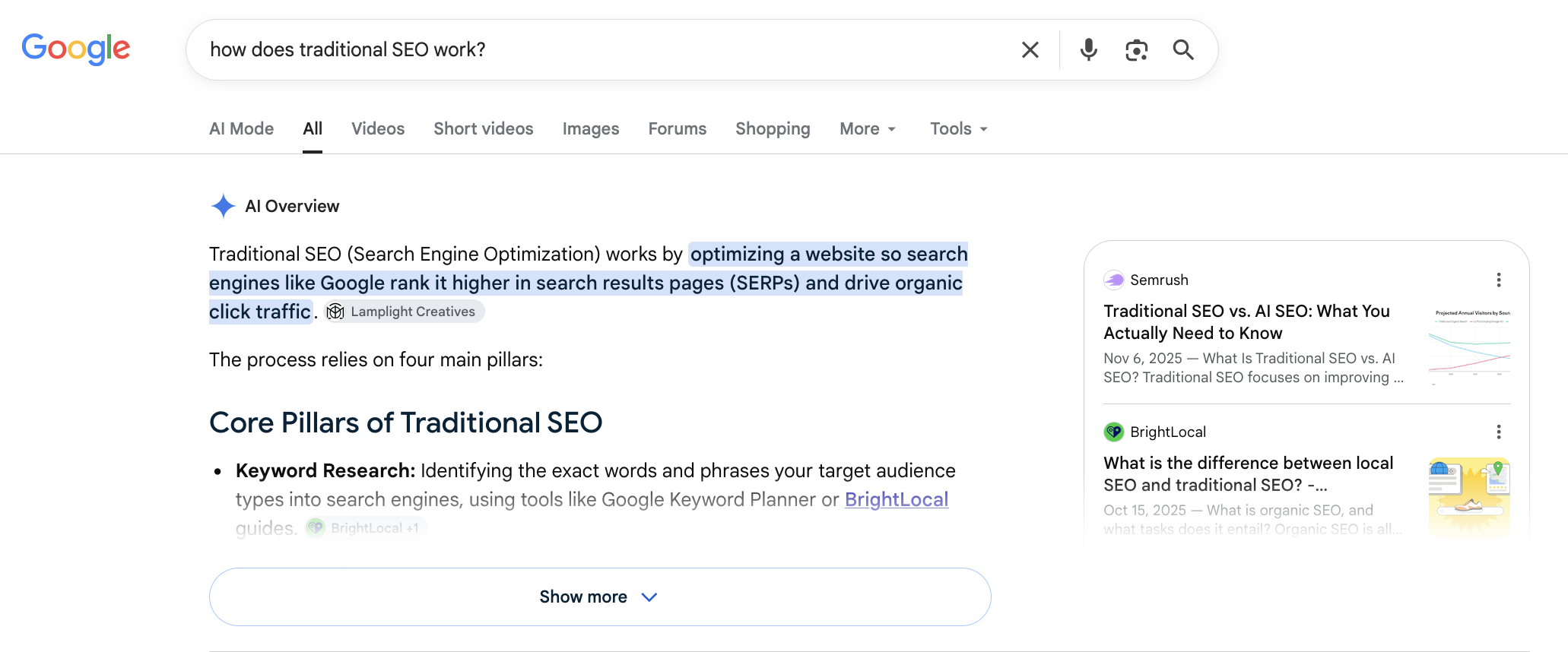
How Traditional SEO Works
Search Engine Optimization (SEO) is the practice of making your website morevisible in organic search results. The goal: get your website’s URL higher up in the list of search results so someone clicks on it and arrives your site.
It's been the foundation of online visibility for over two decades, and it works by helping Google understand what your site is about, how credible it is, and how well it answers what people are searching for.
Website ‘ranking signals’ have historically included factors like keyword use, backlinks (links to other sites), site speed, and how well your content matches a search query.
How AI Search Works Differently
AI search tools don't just index your content, they read it, synthesize it alongside other sources, and generate a direct answer to the user's question. Sometimes that answer includes a citation or link to your site. Often, the user gets what they need without clicking anywhere else at all. Other times, the AI answer introduces them to sources they want to explore further.
This changes the goal for companies who want to be found online. Instead of optimizing for a ranking position, you're optimizing to be the source an AI draws from — to be cited, quoted, or referenced in the answer itself.
The emphasis is shifting, but the fundamentals haven't disappeared. AI systems need to find, understand and assess information before they can use it in an answer. That makes things like clear, specific, useful content and demonstrated first-hand knowledge increasingly important — alongside the technical SEO fundamentals that help search engines discover and understand your site.
What is GEO and AEO?
You may have come across these acronyms recently (marketers love acronyms). While they aren’t crucial to know in the operation of your day-to-day business, they’re helpful to understand.
GEO (Generative Engine Optimization) refers to optimizing your content to be cited or ‘surfaced’ in AI-generated responses — the outcome you're working toward.
AEO (Answer Engine Optimization) is the practice of structuring content to directly answer specific questions — it's essentially how you write to get referenced.
The two overlap heavily, and most people in the SEO industry use them interchangeably. There isn't universal agreement on exactly how these terms should be defined. For practical purposes, I like to think of it this way: GEO is the broader goal of increasing visibility in generative AI search, while AEO focuses on structuring information so it can directly answer questions.
Has GEO Replaced SEO?
No, GEO has not replaced traditional search (SEO). Instead, it acts like an extra layer or an extension to SEO. Each of these search platforms has a different focus:
SEO is about being found
GEO is about being referenced
What Makes Content Perform Well in AI Search
AI tools tend to pull from content that does a few things well:
Answers a specific question directly. Not general background on a topic, but a precise, useful response to something your audience actually asks. The more specific, the better.
Has clear structure. Headers that reflect real questions, short paragraphs, scannable formatting. Clear structure makes content easier for both people and search systems to understand.
Demonstrates real expertise. Named authors, credentials, first-hand experience, and content that reflects genuine knowledge rather than generic information. This aligns with Google's longstanding emphasis on experience, expertise, authoritativeness and trust (also known as “E-E-A-T”), particularly the value of first-hand experience and reliable information.
Uses natural language. Phrasing your headers and content the way a person would actually ask a question helps AI tools match your content to relevant queries.
Includes specificity. Stats, named frameworks, concrete examples. Vague content gets passed over; precise content gets extracted.
How Does SEO Still Matter?
Traditional SEO still matters because GEO and SEO are complementary approaches. AI search tools draw from well-optimized, credible websites, so strong SEO supports your AI visibility as well.
The difference is emphasis:
Traditional SEO rewards technical optimization and authority signals
AI search rewards clarity, specificity, and genuine usefulness
The businesses that tend to perform well in AI search are the ones that have always produced strong content — they're just now getting an additional channel of visibility for it.
Is SEO Changing?
This is a question marketers and business owners are asking everywhere right now, and the consensus among people doing this work day-to-day is more nuanced than the click-baity headlines like "SEO is dead."
The core fundamentals haven't changed much at all. Pages that are genuinely useful, well-structured, and trustworthy still perform.
What has changed is distribution. Search used to funnel almost entirely through Google's list of links. Now that traffic is split across AI overviews, chatbot answers, Reddit threads, social platforms, and other discovery channels.
The destination is the same; the paths people take to get there have multiplied.
This also means visibility now depends on more than your own website. Where your business gets mentioned — in a relevant Reddit thread, a comparison article, a forum answer — increasingly shapes whether AI tools surface (reference) you as a trustworthy source. Reputation is being built across platforms now, not just on-site.
Practically, this means showing up beyond your own content in community discussions, video, and other corners of the web where your audience is asking questions.
The goal to be the clear, trustworthy answer hasn’t changed, but counting on a single channel to deliver visibility is riskier than it used to be.
What This Means in Practice
The objective now isn't only about optimizing your own site for SEO, it's about making sure your business shows up clearly wherever your audience is looking. For most small businesses, that doesn't require an overhaul of existing SEO plans, it only requires intention. For example:
Ensure your service pages clearly explain what you do, who you help, and how
Add FAQ sections that answer the real questions your clients bring to you
Write blog content that goes deep on specific topics rather than staying general
Make sure authorship and credentials are visible on the pages you publish
Consider how your content reads as a direct answer — not just as background information
Pay attention to where your business gets mentioned beyond your own site since AI tools draw on that wider footprint too, e.g. reviews, forums, local press, partner pages